nuancedTheology · A lesson for your family
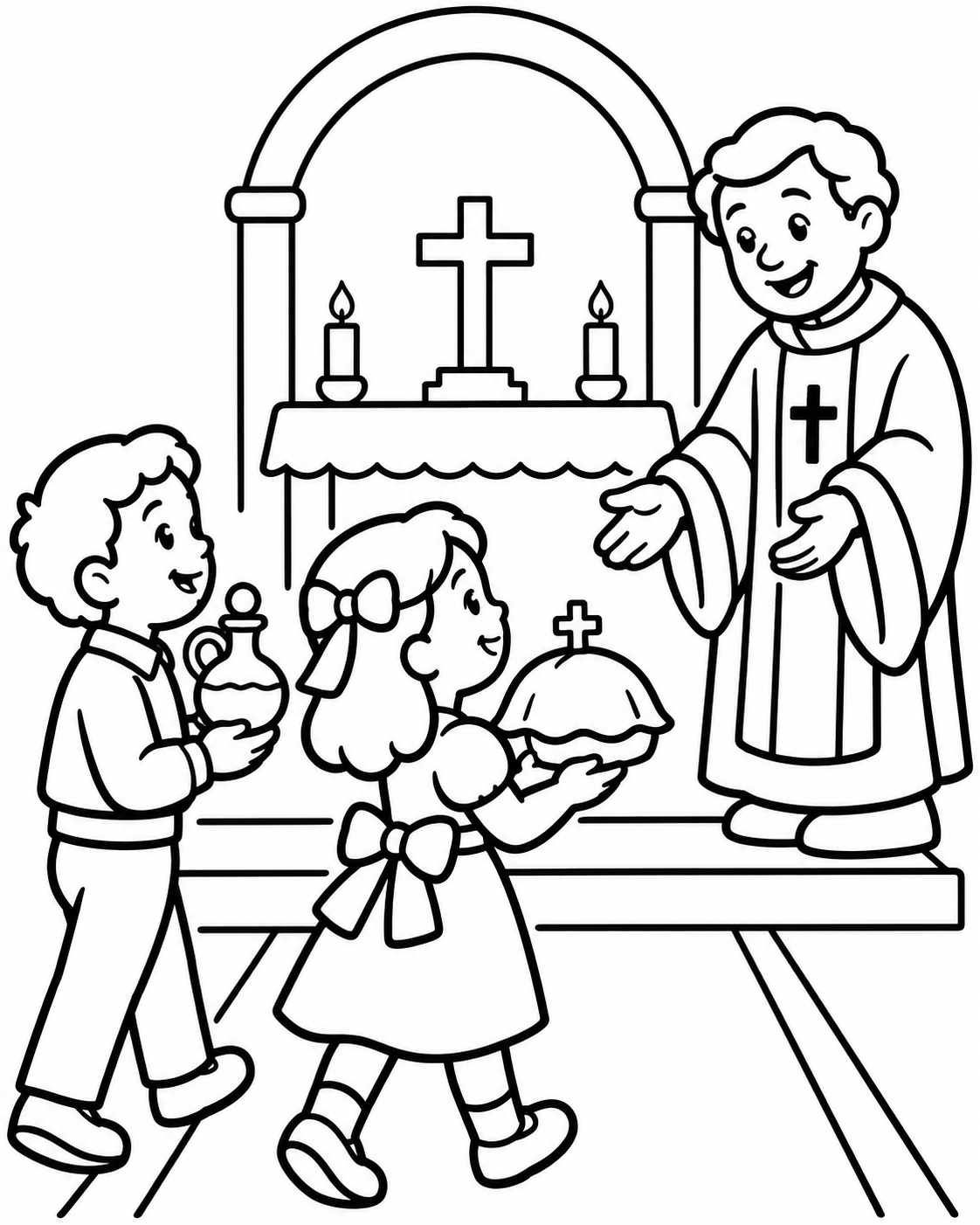
Bringing bread and wine to the altar
Gather together. Read aloud. Leave room for little questions.
Read God’s Word
Paul asks Christians to offer their whole lives to God and care for one another. Listen for how everyday life can become a response to God’s mercy.
Romans 12:1–5 · Douay-Rheims Bible
1 I beseech you therefore, brethren, by the mercy of God, that you present your bodies a living sacrifice, holy, pleasing unto God, your reasonable service.
2 And be not conformed to this world: but be reformed in the newness of your mind, that you may prove what is the good and the acceptable and the perfect will of God.
3 For I say, by the grace that is given me, to all that are among you, not to be more wise than it behoveth to be wise, but to be wise unto sobriety and according as God hath divided to every one the measure of faith.
4 For as in one body we have many members, but all the members have not the same office:
5 So we, being many, are one body in Christ; and every one members one of another:
Wonder together What part of our week could we offer to God?
Want to read more?
Let’s Learn
Read aloud together · about 5 minutes
Ordinary gifts, an extraordinary purpose
Bread and wine are brought to the altar for the Eucharistic celebration. The altar is prepared, and the priest receives the gifts. These familiar things come from creation and human work; their presence can help us remember that everything good begins as God’s gift.
They are not yet the consecrated Eucharist when they are brought forward. In the Eucharistic Prayer, through Christ’s words and the action of the Holy Spirit, they become his Body and Blood. The preparation leads us toward that mystery.
Bring your life in prayer
Saint Paul invites believers to offer their lives to God. As the gifts are prepared, we can offer our work, worries, gratitude, and desire to love. This does not mean our thoughts turn into the Eucharist; we are joining our lives in prayer to Christ’s gift.
A child might remember a friend who is sad, a task that was difficult, or a reason to say thank you. Nothing impressive is required. The daily life we bring can become a place where God teaches us generosity.
Remember those in need
The Church’s worship and care for the poor belong together. Gifts for the support of the Church and people in need may also be collected. We do not pay a fee to buy God’s grace or make an offering more valuable than another person’s prayer.
A family can practice generosity in many ways, including time and service. As you see the gifts brought forward, ask God to make your heart ready to receive and to share. Thanksgiving grows when it becomes love for another person.
nuancedTheology · Bringing bread and wine to the altar
Let’s Talk
Are the gifts already the consecrated Eucharist when brought forward?
For parents: No. The preparation leads to the Eucharistic Prayer and consecration.
What part of our week could we bring to God?
For parents: A worry, thanks, work, or a person needing help.
Do we buy God’s grace with an offering?
For parents: No. Giving is a response of gratitude and care.
Let’s Remember
We receive God’s gifts with thanks and offer our lives with Christ.
Let’s Practice
Choose one intention to bring as the gifts are prepared at Mass. Plan one small act of generosity afterward.
Let’s Pray
Father, receive our thanks and the lives we bring. Unite us to Jesus and teach us to give generously. Amen.
For Parents
Optional further reading:
USCCB · Liturgy of the Eucharist www.usccb.orgbible.usccb.org
Find more references alongside each section of the article.
Use the Scripture and Catechism references above to find the passages in a Bible or a copy of the Catechism.
Original educational lesson · Version 2 · 2026-10-24
Drafted · Awaiting theological review. No ecclesiastical approval is claimed.